Angela Clifford
British Intelligence And Casement
Basil Thomson (1861-1939) was Scotland Yard’s Assistant Commissioner for Crime in its Criminal Intelligence Department (CID), and of Special Branch (the Political Intelligence Unit) from 1913. He oversaw the Directorate of Intelligence until his downfall in 1925 in a bizarre incident when he was accused of public indecency with a young woman in a London park.
In these roles he worked with MI5 to hunt down both German spies during World War 1, and Communist Subversives in the Trade Union Movement in 1918-21.
Thomson came from an upper middle class family, being the third son of a Provost in Queen’s College, Oxford. He was sent to Eton, then New College Oxford, but developed depression and emigrated to the USA where he took up farming. However he was to rush home when he got the news that the lady he intended to marry was considering an alternative offer. Her family agreed that Thomson might marry his intended if he could secure suitable employment. This was achieved through the influence of his father and he became an assistant to the Governor of Fiji. A succession of colonial positions followed but in 1893 a decline in his wife’s health changed his course. He became a barrister and started writing fiction, publishing racy titles such as The Diversions Of A Prime Minister (1894) and The Indiscretions Of Lady Asenath (1898).
As Thomson’s writing did not provide a sufficient income, he went into prison administration, becoming Governor of three major British prisons in succession, and then becoming Secretary of the Prison Commission in 1913. As a Prison Governor, he gave short shrift to suffragettes on hunger strikes, attended all the executions carried out in his prison with equanimity, and remained an advocate of capital punishment.
World War 1 brought further promotion: to CID at New Scotland Yard. This entailed enforcing War Office and Admiralty instructions in Intelligence matters. A new 114-man unit was established to counter subversion. Here Thomson worked closely with the Home Section of the Secret Service Bureau, investigating espionage, sabotage and subversion, and helped to draft The Defence Of The Realm Act (DORA). Under this the Government could suppress published criticism, imprison without trial, and commandeer economic resources for the war effort. Publication of information “indirectly or directly of use to the enemy” became an offence, covering any description of the War, and any news causing friction between the public and military authorities.
In an atmosphere of war fever, these moves sparked spy mania in the general public, but in the event very few spies were tried and executed.
Maundy Gregory
It seems that Basil Thomson recruited Arthur Maundy Gregory—described by researcher Brian Marriner as compiling “dossiers on the sexual habits of people in high position, even Cabinet members, especially those who were homosexual, and engaging in blackmail” https://jiescribano.wordpress.com/2021/04/21/sir-basil–1861-1939/#:~:text=In%201913%20%20was%20appointed,(CID)%20at%20New%20Scotland%20Yard.
Thomson claimed that it was Gregory who drew his attention to Roger Casement:
“Gregory was the first person… to warn that Casement was particularly vulnerable to blackmail and that if we could obtain possession of his diaries they could prove an invaluable weapon with which to fight his influence as a leader of the Irish rebels and an ally of the Germans”.
Casement was to be arrested on 21st April 1916 on charges of treason, sabotage and espionage.
A strange aspect to this story is that Victor Grayson—a colourful Independent Labour Party MP 1907-1910, who was born in 1881—disappeared without trace on 28th September 1920. He had accused Lloyd George of selling honours…” ( https://en.wikipedia.org/wiki/Victor_Grayson#:~:text=Albert%20Victor%20Grayson%20(born%205,of%20the%20early%2020th%20century.)
But, more to the point in this story, Grayson also suspected Gregory of forging the ‘diaries’ used to convict Casement of treason, according to Wikipedia. However, instead of drawing the appropriate conclusions from these facts, the Wikipedia entry hastens to add that “although it later turned out that Casement had engaged in the homosexual activities described…” ! No sources are given for this bald assertion.
Thomson
Inspector Basil Thomson wrote a number of fictional works, and a memoir of his time in Intelligence, entitled Queer People in 1922. This has been republished as a chapter in Odd People, Hunting Spies In The First World War (2015), edited and introduced by Michael Smith (October 2014). This book forms part of the Dialogue Espionage Classics Series. It is not clear whether the publisher made other changes beside altering the title. The modern edition lists the copyright being held by “Basil Thomson, 1922, 2015”—which is strange, considering he died in 1939!
Smith’s Introduction states that Thomson was contemptuous of MI5’s efficiency during this period and wanted to take it over, as well as wishing to purge left-wing elements from the Labour movement—ultimately bringing about his downfall. He was dismissed in 1921 on the insistence of Prime Minister Lloyd George, ostensibly because of IRA graffiti daubed on the walls of Chequers (the Prime Minister’s newly-acquired country residence). Public disgrace followed upon a 1925 incident in Hyde Park (London) involving a well-known prostitute, Thelma de Lava. However his friends claimed that it was a ‘sting’ aimed at discrediting him—which Michael Smith is inclined to accept.
‘Odd People’
Basil Thomson writes that Lord Haldane had made war plans in advance of World War I, and that the Government had a list of German spies and details of the network in advance of the War (p34), adding that the population was beset by spy mania.
In a summary of Casement’s activities, Thomson writes: “I do not believe any disloyal thought had entered into Casement’s head before the war” (p74). That is a strange thing for an Intelligence Chief to write. Casement spent years before the War warning of British war plans in newspaper articles published in various journals, many of which have been reproduced by Athol Books.
Writing about the source of Casement’s alleged ‘diaries’, Thomson writes—
“…when we first had evidence of Casement’s treachery, his London lodgings had been visited and his locked trunks removed to New Scotland Yard. Towards the end of the interview a policeman entered the room and whispered to me that Casement might have the key to the trunks. I asked him and with a magnificent gesture he said, ‘Break them open; there is nothing in them but clothing and I shall not want them again.’ But something besides clothing was found in one of the trunks—a diary and a cashbook from the year 1903 with considerable gaps. A few days later Casement must have remembered these volumes, for his solicitor demanded the surrender of his personal effects. Everything except these books was sent to him and there came a second letter pointing out that the police must still be retaining some property. It is enough to say of the diaries that they could not be printed in any any age or in any language.
“During a subsequent conversation Casement said, ‘You failed to win the hearts of the people when you had your chance’.
“I replied, ‘You are speaking for a minority of the Irish People’…”
Hints At Homosexuality
Below are some extracts in which Thomson hints at Casement’s homosexuality, as well as casting doubt about his revelations about Belgian atrocities in the Congo. It might be remembered here that such allegations of homosexuality had been circulated amongst certain members of the elite during the criminal proceedings for treason. They did not form part of the prosecution case. Thomson’s remarks are offered to readers so that they can draw their own conclusions:
“Casement struck me as one of those men who are born with a strong strain of the feminine in their character. He was greedy for approbation and he had the quick intuition of a woman as to the effect he was making on the people around him. He had a strong histrionic instinct. I have read many of his early letters. They are full of high ideals that ring quite true and his sympathy with the downtrodden and his indignation against injustice were instinctive; but, like a woman, he was guided by instinct and not by reason and where his sympathies were strongly moved it is very doubtful whether any reliance could be placed upon his accuracy. I have often wondered how much accuracy there was in his revelations about the Congo and the Putumayo. Colleagues who served with him in his official days have told me that he never took his statements quite literally. They always allowed for imaginative colouring.
“A few days before his execution he received a telegram from the person who had been most injured by his statement about Putumayo, imploring him at that most solemn moment to retract his unjust charges. As far as I know, he did not reply to this telegram. I have made special inquiry with a view to ascertaining how long Casement had been under the obsessions disclosed in the pages of his diary and I feel certain that they were of comparatively recent growth, probably not much before the year 1910. This would seem to show that some mental disintegration had begun to set in, though it was not sufficient to impair his judgement or his knowledge of right and wrong.”
Further on, Thomson remarks—
“His colleagues could not decide whether the curious swagger in his walk was due to self-satisfaction or to a physical peculiarity…
“He had a way of wearing his coat without putting his arms into the sleeves and he had his overcoat made without sleeves, possibly with an eye to the picturesque. He was a clear and forcible writer and was quite indifferent to money, though he kept his private accounts meticulously…”
Angela Clifford
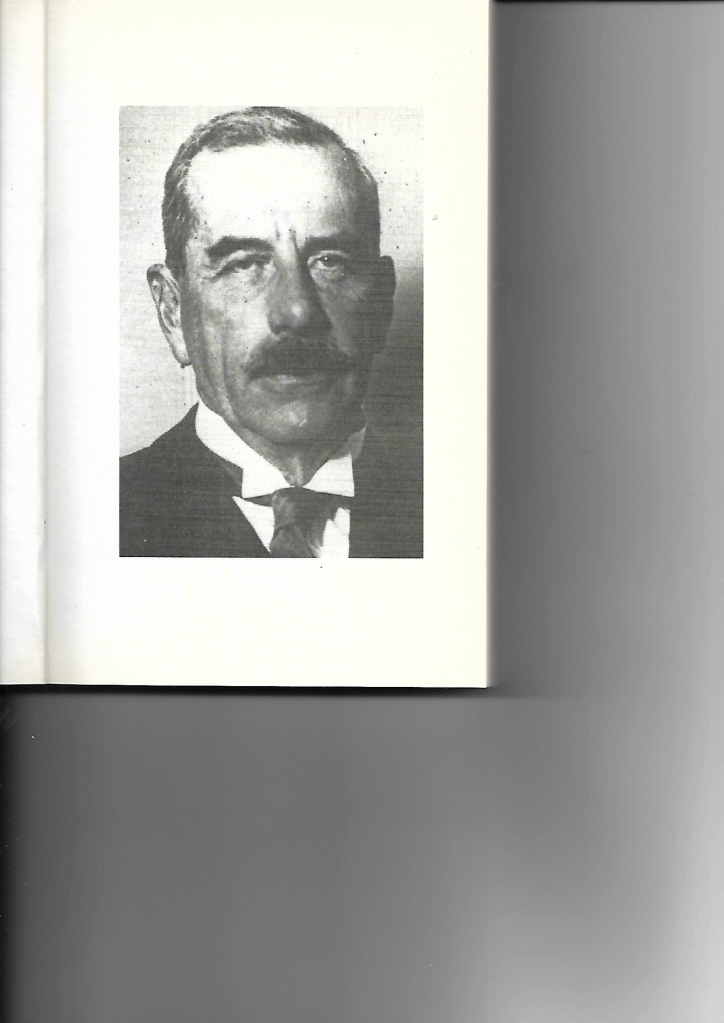
Basil Thomson

