Dear Editor,
I would like to address several of the issues on Casement’s diaries raised by John Martin, Tim O’Sullivan and Paul Hyde in December’s Irish Political Review, and correct or clarify some of their mistakes.
Tim calls these (few) issues “anomaly clusters” believing that, singly, they don’t prove forgery unlike John Martin who states if one is false all are.
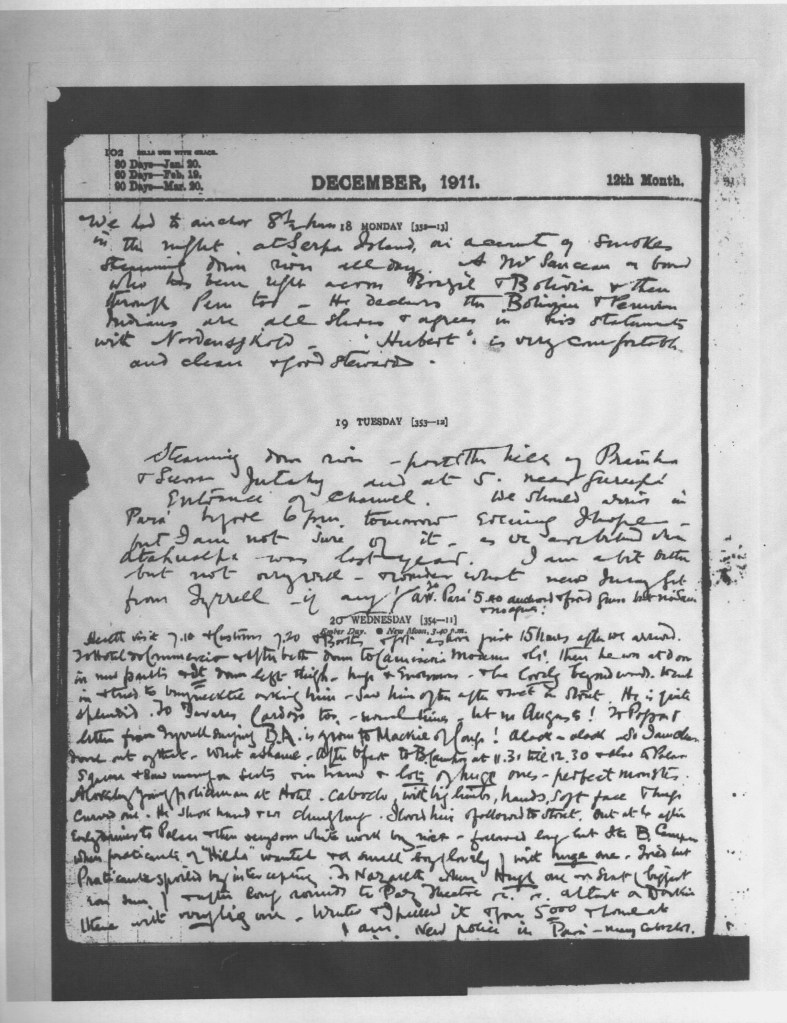
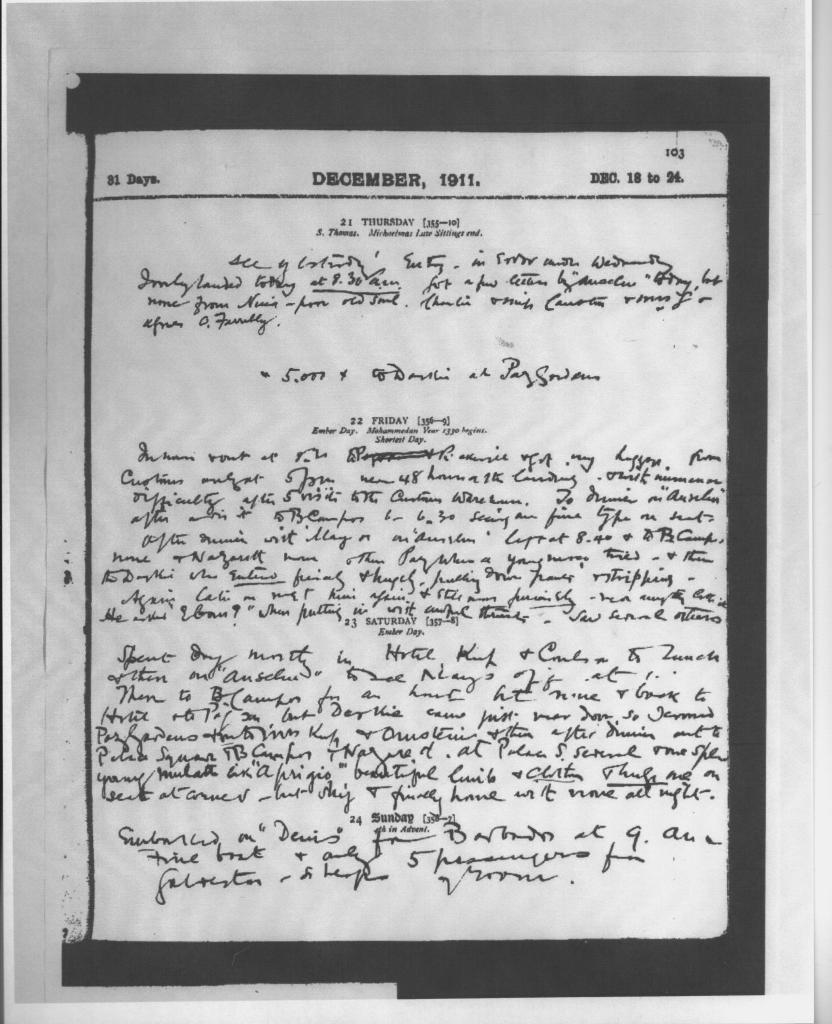
1. In relation to Casement’s arrival in Pará from Iquitos and Manaos in December 1911 on apparently different days, I have to admit I had not worked out the sequence of events. However on close inspection of images of the two diary pages (attached) I was able to clear the matter up.
Paul discovered Casement’s arrival in Pará was indeed recorded in a local newspaper as Thursday 21 December 1911. This is of course confirmed by Casement’s diary entry on that Thursday when he wrote “See yesterday’s entry – in error under Wednesday. I only landed today at 8.30 a.m.”
His admitted error was to write his Thursday diary entry in the Wednesday slot as he had not written anything that day while on board ship sailing toward Pará. He arrived on the evening of Wednesday but was not allowed to disembark until the next morning. At a later point, at the end of his Tuesday diary entry, he did manage to squeeze this sentence in:
“20 arr. Pará 5.40 anchored & fired guns but no ‘San’ & no agents:”
That figure of 20 is placed above the next word ‘arr.’ and is linked by a curved insert line drawn down to the printed heading for the next day of ‘20 WEDNESDAY’.
He thus had to insert his Wednesday evening arrival time at the end of the Tuesday entry as he had already erroneously filled Wednesday’s space with the (sexually busy) events of Thursday. He then corrected the dating error within, an otherwise sparse, Thursday entry.
Why would forgers, working initially by creating a typescript, as Paul Hyde believes, retain all this confusion rather than typing the page again?
The Brits are credited with amazing skill given their juggling of thousands of facts in the diaries about obscure countries in the middle of the 1st World War, and for a prolonged dedication to forgery. Yet we are asked to believe they couldn’t retype an erroneous page.
2. John Martin restates Hyde’s view that, suspiciously, the 1910 “Black Diary avoids using the future tense”. I have to point out when I checked the 1910 diary transcript I found some fifty uses of the word ‘will’ and ten of ‘shall’, all indicative of future activities thus denying Paul’s assertion. (I excluded mention of the guardsman ‘Welsh Will’.)
3. On one of the disputed aspects around who bought Millar Gordon’s £25 motorbike, which sale Paul and John accept happened, Paul relies heavily on the NLI document 15138/1/12 where Casement listed about a dozen items of expenditure. One reads “Millar 25.0.0”. Paul says its mention on the list proves Casement did not pay for the bike, rather he gave Millar £25 for some other reason. If the £25, which is about £2,500 at today’s values – was not for the bike purchase, it was a significant gift for the 21-year-old.
Paul, although not John, believes the bike was purchased from Essex-based Cyril Corbally (Lady ffrench’s brother) just not by Casement. Tim disagrees reckoning the Essex registration records were tampered with to frame Millar. So we have three opposing versions of the purchase with my diary-based one being a fourth.
Hyde, relying oddly on this paper which had been in the hands of Scotland Yard, insists, “In fact it is a list of bank cheques sent by Casement to various persons in 1911”.
But it isn’t. It is a list of large payments made over the period April to August 1911, some accumulated. They appear to be mostly gifts, loans or repayments of loans. Casement’s three siblings and a niece feature heavily. Many items can be tracked in the 1911 journals and some also to his cheque stubs in the NLI.
Casement’s brother Tom is listed as receiving one payment of £25. Brother Charlie is given £86.15.0 and Nina, his niece a present of £5. Nina his sister is given £105, being an accumulation of three regular quarterly payments although none are added to the total. Caroline Bloxham in Belfast receives two amounts listed under “Caroline 15.0.0.” Casement reluctantly lent her £10 in April, where she is described on the cheque stub as “Caroline Bloxham (Mrs McCullagh)”, and then £5 in July.
“Refund Dick 32.10.0” also covers two items. Casement helpfully explained this on a cheque stub: “28 April 1911 £20.0.0 Richard H Morten Part Repayment of Loan. This leaves £12 10/- still due to Dick”. This is repeated in the Cash Ledger entry of the same date as “£20 Refund to Dick Morten of £20. Leaves balance of £32.10/- -) £12.10/- now due.” That amount is duly repaid on 24 July being recorded as, “Cheque to Dick Morten £12/10/-”.
On the back of the list are calculations of year-to-date expenditure starting with £515.11.7. The July and August totals are then added with certain refunds deducted. That first figure appears twice in the 1911 Cash Ledger described as expenditure “for First Six Months of 1911”.
4. John reckons the ffrench connection is “tenuous” given Casement only diaries meeting the couple twice in 1911 (actually once also in Dublin). Paul argues that “a friendship is doubtful” as they are not “listed in two of Casement’s address books”. But in December 1912 he received two letters from Mary ffrench at London addresses regarding a possible job in Mozambique, one ended “Love from us both”. He even visited her mother-in-law in Ailesbury Road in 1904 and she later wrote to him.
Lady ffrench in 1920 memorably wrote up her impression of Casement: “Although I liked him and we made friends, he did not fire me to any great extent with enthusiasm for his causes and ideals in the way he did most people who admired him. I felt that mentally he lived on a different plane. I am quite sure that Roger Casement, even in his most condemned actions, had the highest motives for what he did. He saw things like that and he could not see them otherwise. Moreover, unlike most idealists he was prepared to sacrifice himself. He was the only man of my acquaintance who could wear a beard and get off with it.” (NLI 13073/6)
Jeff Dudgeon
Belfast
14 December 2025
Two pages of the alleged diaries:
Reply to Jeffrey Dudgeon by John Martin
I refer to the sections of Jeffrey Dudgeon’s letter.
1) Errors in dates and times are more likely to occur if a document refers to events in the past than if it is written contemporaneously.
Jeffrey Dudgeon makes an attempt to explain away the errors in the Black Diary but he begs more questions than he answers.
Interestingly, the main error relates to various sexual activities which are written in the space for Wednesday 20th of December of the 1911 Black Diary. The activities begin before breakfast and end at 1.00am the following morning.
There can be no dispute about the error. The diarist could not have done anything in Pará on Wednesday because the boat did not arrive there until Wednesday evening and the passengers were not allowed to land until the following morning. Casement’s arrival on Thursday is confirmed by a local newspaper report.
At this stage readers might ask themselves if this is a mistake that a contemporaneous diarist would make?
Jeffrey thinks the mistake occurred because the Wednesday space in the diary was blank. He proposes that the diarist wrote up his Thursday experiences in the Wednesday space. But the question arises as to why the Wednesday slot should have been empty. After all on Wednesday a significant event had occurred. The boat had arrived at Para: an event which the diarist had anticipated in his Tuesday entry.
So, at some stage, the diarist realised his error, but when? I am convinced it was several years after the diary date of 20th December 1911—and may even have been after Casement’s death, but let us look at it from the perspective of the forgery deniers.
If the events in the Wednesday slot of the diary had in fact happened on Thursday, then those events were completed at 1.00am in the early hours of Friday morning. The diarist could only have written about his experiences after 1.00am. Once he had written about the alleged events of Thursday, it might be wondered how much time elapsed after 1.00am on Friday before he realised that he had entered them in the Wednesday slot in error.
The first sentence in the Thursday slot of the typescript recognizss the error. It says: “See Yedy’s entry, in error made under Wednesday”. But this could only have been written well into Friday morning. Therefore the next sentence is a little curious. It says: “I only arrived to–day at 8.00am”. It is as if the diarist or forger has forgotten that the various alleged erotic events of Thursday had run into Friday morning! Therefore that ‘today’ was not written on Thursday as alleged.
Then, rather strangely, the diarist completely changes pace and in the same Thursday slot says:
“Got a few letters from “Anslem” to-day but none from Nina—poor soul, and Charlie and Miss Causten and MrsG. and Agnes O’Farelly”. The diarist mis-spells the name of the vessel and of a close friend.
He finishes the Thursday entry with another suggestion of a sexual transaction:
“5.000 to Darkie at Paz Gardens.”
Why didn’t he mention that earlier when he was describing the other sexual activities of Thursday?!
But it gets better! At some stage—possibly to help authenticate the diary—the diarist or forger decided that it would be a good idea to note the arrival time of the boat. The only problem was that he entered the date in the Tuesday slot, whereas the actual arrival was Wednesday evening.
The typescript from Scotland Yard says:
“Arr. Para 5.40 anchored and fired guns but Saida and no agents”.
How could a diarist writing contemporaneously mistake the date of arrival of the boat? Jeffrey quotes from the handwritten diary which rather strangely has a number of corrections, indicating that the diarist or forger was aware of the correct date that the boat arrived even if the person who typed the copy of the handwritten diary was not!
But the question remains: if the diarist knew that the boat had arrived at 5.40pm on Wednesday, why did he enter it in the Tuesday slot? The Tuesday slot already had writing in it. So the same excuse for the error in the Wednesday entry cannot be used.
Jeffrey comes up with the only possible plausible explanation: the reason why the arrival of the boat was not put in the Wednesday slot was that this space was already filled with the diarist’s alleged sexual antics of Thursday.
But Jeffrey fails to draw out the implications of what he is saying. The observation that the boat arrived on Wednesday evening could not have been written before Friday morning!
Jeffrey seems to think that the diarist’s correction of his errors is proof of authenticity. I actually believe the opposite. The frantic correction of the errors indicates that the diarist or forger was acutely aware that the diaries would be shown to other parties. That is something that would not have been of concern to an authentic diarist since it is abundantly clear that the diaries—as intimate records of criminal behaviour—were not intended to be shown to anyone else.
Jeffrey wonders why the police didn’t correct the typescript once they realised their errors. It is probable that the errors were not noticed before the typescripts were shown to influential public figures. Once this was done it would have invited suspicion to show a different version to other people. Some discreet amendments was the safer option. It is a fact that multiple copies of the police typescripts were made under time pressure which complicates precisely how multiple corrections could be made.
2) I checked Paul Hyde’s book (page 61) and wish to confirm that he did not refer to the future tense; he referred to “future aspect”. Aspect in linguistics is quite distinct from verb tenses. In this case it relates to temporal dynamics and the flux of time as lived.
I cannot say if Paul’s theory is amenable to a textual analysis, but if it is it would require a comparison between a black diary and an undisputed diary such as the Amazon Journal. An analysis of a Black diary on its own, as Jeffrey attempts, would be a pointless exercise.
3) In this section it is a little difficult to follow Jeffery’s logic. In the first paragraph he says Paul and I accept that the sale of a motorbike happened.
Then in the next paragraph he says that I do not believe that a sale happened.
There is no substantial disagreement between myself and Paul on this point. We both agree that Cyril Corbally sold his motorbike but we do not believe Casement was involved.
I don’t know why Jeffrey thinks the list of payments in the NLI document was not a list of cheque payments. They were hardly electronic transfers!
I sense Jeffrey is not quite at ease with the NLI document and he suggests that it is odd that Paul relies on this document which had been in the hands of Scotland Yard. Does Jeffrey think it was tampered with; and if so, for what reason?
In this regard I note that Jeffrey Dudgeon hasn’t responded to the point I made about him leaving out the following in the third edition of his book:
“It is possible that Millar bought the motor bike from Corbally and that Casement was repaying him as a separate note listing expenditure simply reads ‘Millar 25.0.0’…”
4) Jeffrey’s ffrench connection remains tenuous. He finds one other meeting of the ffrench couple in Dublin, a couple of letters, and a meeting with the mother-in-law in 1904.
But still no evidence of any direct connection between Cyril Corbally and Casement.
John Martin
 Irish Political Review