OBITUARY
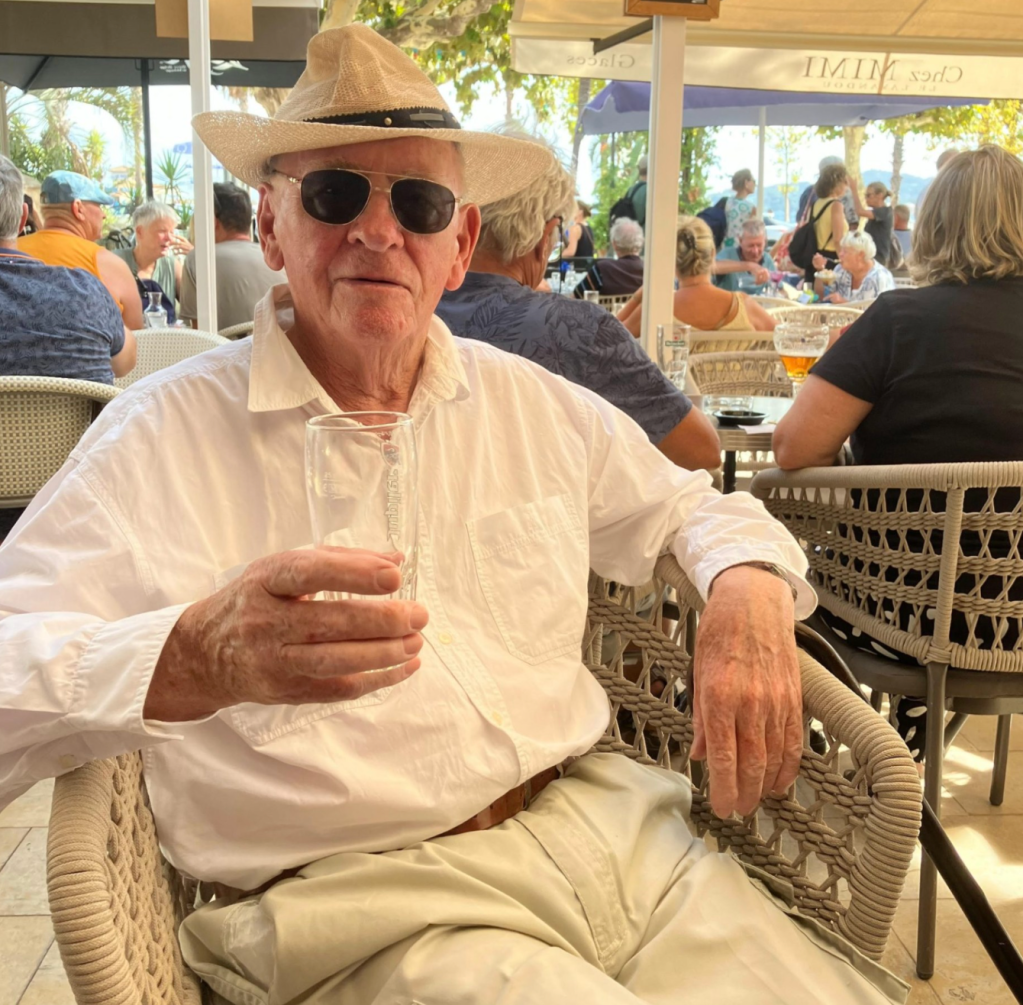
Donal Mahon Kennedy, 28/12/1941- 9/10/2025
Friends of Donal and readers of this magazine will be well aware of Donal’s erudition on politics and history particularly in relation to Ireland and also on world affairs. This together with his passion, wit and humour made him a most attractive personality.
I first became aware of these qualities when I noticed his middle name and asked him why Mahon? He explained that his family traced their lineage to the Kennedys of the Dal Cais whose first great leader was King Mahon or Mathgamain, son of Kinnéidi.
His story is one of the most dramatic in the Irish Annals. In the 10th century he was a ‘new kid on the block’ among Munster clan leaders and the arrangement among the other Clan leaders of Munster was that they rotated the Kingship of Munster based in Cashel. When Mahon got his turn he did not want to relinquish it and some of his peers assassinated him at the foot of Mushera mountain in North Cork in a townland called Finanefield in 976.
The event is recorded in detail in the “War of the Gaedhil with the Gall”. However the assassins, O’Donovan and O’Mahony, did not reckon on the reaction of his young brother, Brian Boru, who set out to avenge Mahon’s killing and in turn killed the assassins becoming King of Munster and proceeded to become the first real High King of Ireland. The rest is history.
Donal named his son Brian no doubt in honour of Brian Boru which could be interchangeable with Brian Kennedy. Tradition has it that the descendants of the assassins cannot have Brian as a forename. A monument to commemorate Mahon’s killing, “Mahon’s Rock”, was erected at the murder site in 2014 and opened by a 42nd direct descendant of Brian Boru.
Goethe said that “He who cannot call on three thousand years is living from hand to mouth.” Donal did not live from hand to mouth in his understanding of himself and the world.
He attended Rockwell College and studied science and engineering as these subjects were encouraged by the de Valera government at the time. But his heart was in the arts rather than these subjects. After school he joined Irish Shipping as a clerk. He visited London in the swinging sixties and decided to stay. He married Barbara in 1971. He studied at the de La Salle college in Manchester. He became fully involved in Irish Community’s cultural life and politics and was a member of the Connolly Association. Later he became a librarian. He was a regular contributor to the Irish Post, the Irish Democrat and this magazine.
He left a most extensive archive of books, pamphlets and newspapers which have been donated to the Irish Cultural Centre in Hammersmith.
Donal was born and reared in de Valera’s Ireland and was a committed admirer and defender of its values and culture which he saw as positive and fulfilling despite shortcoming that are not unique to it. Readers will be well aware of why he held these views. One of his ambitions was that there would be a de Valera Society to do him justice as one of the great statesmen of the 20th century.
Ar dheis Dé go raibh a anam dílis.
Jack Lane
Eamon De Valera: We Should Be All So Hated!
Recently I discovered on You Tube a programme put out on BBC called Ireland’s Hated Hero.
I was somewhat surprised that the subject was Eamon de Valera and I’ve been searching to establish exactly how ‘hated’ de Valera was. I found out that, in the 42 yeas between 1917 and 1959, he had been a Member of Parliament for a County Clare constituency in the Province of Munster, having been returned on 16 consecutive occasions.
He had additionally, twice during those years been elected as an MP for Mayo, in the Province of Connaught.
Following Partition in1921, ‘DEV’ had simultaneously been elected to the ‘Northern Ireland’ Parliament, in the Province of Ulster as an abstentionist. From 1922 to 1929 he was Stormont MP for County Down and from 1933 to 1937 for South Down.
De Valera led democratically elected Governments on 10 occasions. The First followed Sinn Fein’s landslide victory in 1918. The Second after that party’s landslide victory in 1921.
As leader of Fianna Fail, “DEV” led 8 Governments. So he was in power for 24 of the 42 years following his first standing for Parliament. He never entered into Coalition with anyone.
During his tenure there were no “heaves” to replace him, and his colleagues were no ‘yes’-men, nor ciphers, but independent-minded revolutionaries.
When he left Office as Taoiseach, ‘DEV’ did two successive seven-year Laps of Honour as President of Ireland, having defeated strong candidates in yet two more democratic elections.
So much for De Valera’s popular record in Ireland!
In 1932 while serving as head of the Irish Free State Government “DEV” acted as the State’s Minister for External Affairs and attended League of Nations meetings in Geneva. He was elected by the foreign delegates there as President of its Council of Ministers. In 1938 Dev was elected as President of its Assembly. That may be some indication of Dev’s appeal abroad.
But Dev didn’t court popularity in Geneva. He demanded that all its members honour its Covenant to settle international disputes without violence and to protect its weaker members from aggression by stronger ones.
He was prepared to supply Irish Defence Force personnel to a League force, if one was raised to defend Abyssinia from Aggression by the Fascists. He was labelled a firebrand by Anthony Eden for his offer.
Britain had her own way of making Mussolini pay through the nose for the Rape of Abyssinia—into the coffers of the British owned Suez Canal for the passage of the Rapists and their equipment through that waterway.
Mussolini, a British agent since 1917, dubbed a Knight of the Bath by King George V in 1923, had Blueshirt admirers in Ireland who attacked Dev for his ethical democratic stance.
Over 20 years before the eldest of the Beatles was born, De Valera was packing crowds into sports stadia across the United States and was being given official receptions in the capitals of many of those states and civic reception in their cities.
In 1938 The Illustrated London News published photographs of De Valera’s reception at Euston Station which might well have been templates for It’s A Hard Day’s Night!
Crowds invaded the platform, climbed on the roofs of carriages, running on them holding Tricolours aloft.
I believe it was the occasion when Dev came to London for the agreement which saw the evacuation of Cork Harbour, Berehaven and Lough Swilly by the British Forces.
No wonder Dev was so hated!
(IPR, February 2025, Donal Kennedy)
 Irish Political Review